


Crypto companies still get VASP licenses in 2026. They just cannot get them inside the European Union anymore. Switzerland, the United Kingdom, Gibraltar, Jersey, Bosnia and Herzegovina, and Georgia all operate their own VASP registration systems.
Each jurisdiction follows FATFA guidelines but sets its own capital rules, processing speeds, and physical presence requirements. A Swiss SRO membership takes two to four months. Bosnia processes applications in three to six months. Jersey runs eight to fourteen months. The right choice balances startup budget, customer locations, and whether banks in that jurisdiction open accounts for crypto firms.
The seven firms listed below have all completed VASP applications in these countries. Each one knows which regulators currently move fast and which jurisdictions charge zero percent corporate tax on digital asset transactions.
Quick Market Overview
The global VASP landscape has shifted dramatically. Pre-MiCA Europe had over 3,000 registered VASPs, with Poland alone accounting for more than 1,400 registrations. As of May 2026, only 194 authorised CASPs exist across the EU, and an estimated 75% of the pre-MiCA VASP population will lose registration status when transitional periods expire on July 1, 2026.
Outside the EU, different dynamics apply. Switzerland processes SRO membership in 2-4 months. The UK’s FCA takes 6-18 months, with rejection rates above 50%. Offshore hubs like the BVI and Cayman Islands offer zero corporate tax but require economic substance.
This list covers firms that know these differences and have done the work in active VASP jurisdictions.
1. Gofaizen & Sherle
For crypto exchanges and custodial services that need VASP licensing across multiple non-EU jurisdictions, with one firm coordinating everything.
As a legal consulting firm for crypto business, Gofaizen & Sherle has handled licensing work in more than 50 countries without outsourcing to external partners. The team’s internal offices across Europe, Latin America, Asia, Canada, the USA, and Hong Kong all operate under one roof. Each licensing project stays within the firm from start to finish.
Their crypto license law firm capabilities for VASP registration include Switzerland (SRO membership or direct FINMA license), the United Kingdom (FCA AML registration), Gibraltar (DLT license), Jersey (VASP Regime 2023), Bosnia and Herzegovina (Republika Srpska VASP license), and Georgia (mandatory VASP registration).
VASP licensing timelines vary dramatically by jurisdiction. Switzerland takes 2-12 months, depending on the SRO or FINMA route. The United Kingdom requires 6-18 months, with a high rejection rate. Bosnia delivers in 3-6 months. Georgia processes registrations in 4-8 months. The firm’s crypto licensing lawyers map each client’s business model to the right timeline.
Cost structures differ just as much. Bosnia costs USD 10,000-15,000. Jersey requires USD 100,000-150,000. Gibraltar runs USD 80,000-120,000. Georgia offers registration for USD 15,000-30,000. Gofaizen & Sherle’s crypto business setup law firm team presents all options before any application moves forward.
The firm’s crypto company setup lawyers have structured VASP registrations for exchanges, custodial wallets, OTC desks, and token issuers. Their crypto licensing legal advisors support both emerging and established operators entering non-EU markets. Gofaizen & Sherle is a top legal consulting firm for crypto licensing with physical offices across six continents and a proprietary jurisdiction selection methodology.
Partner Viktoria Randalainen brings over six years of FinTech and crypto industry experience, having assisted with more than 400 projects. Consultant Robert Pekin specializes in global licensing support, including MSB readiness in Canada and the US, plus VASP and CASP licensing across Estonia, Lithuania, Poland, and Czechia.
This crypto business legal setup firm builds regulatory structures that keep working between supervisory cycles, not just one-off approvals.
2. Stalirov & Co
For US-anchored crypto projects that need VASP registration in the EU, UAE, and offshore jurisdictions without switching law firms.
Stalirov & Co is a crypto license law firm based in Princeton, New Jersey. The firm’s crypto licensing lawyers handle US MSB registration with FinCEN and state Money Transmitter Licenses across all 50 states, plus VASP licensing in Europe and the UAE.
Their crypto license lawyers cover Estonia, Malta, and the UAE for crypto exchange and custody licenses. The firm also advises on regulatory compliance with SEC, FINRA, CFTC, FinCEN, and FATCA requirements in the US and the EU.
The firm operates with 14 in-house lawyers and business analysts who understand payment integrations and technical infrastructure. Their services include AML/KYC compliance programs, tax consulting with legal opinions on unique tax conditions for crypto businesses in the US and the EU, GDPR/CCPA compliance, and NFT project launch support.
Stalirov & Co helped Intellabridge, a fintech company operating on the Canadian Securities Exchange and OTC Markets, through a full legal and compliance review covering Europe, the USA, and Asia. The team structured integrations with Prime Trust (US crypto-custodian) and Solarisbank (German banking license).
3. Crypto License Services
For crypto founders who want to compare VASP jurisdictions before committing to a licensing path.
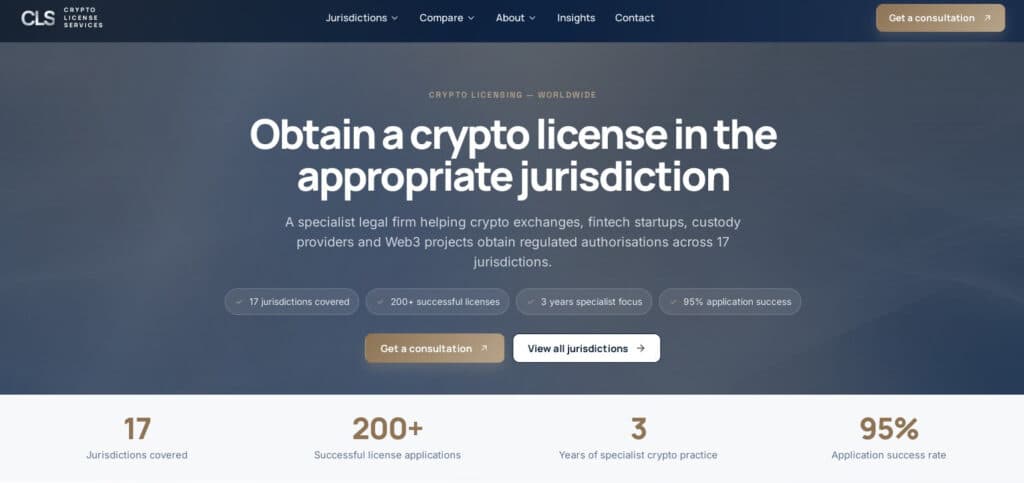
Crypto License Services operates as an educational and matching platform for VASP and crypto licensing. The firm publishes detailed comparisons of licensing requirements across multiple jurisdictions.
Their crypto licensing attorneys have mapped six popular jurisdictions: Abu Dhabi ADGM, Switzerland SRO, Poland VASP (pre-MiCA), Australia DCE/AFSL, El Salvador BSP/DASP, and Canada MSB. The platform tracks regulatory developments, including Poland’s legislative stagnation following the presidential veto of the Crypto-Asset Act in February 2026, which has stalled MiCA implementation.
Switzerland’s SRO pathway takes 2-4 months and costs CHF 20,000-50,000, making it one of the faster routes to VASP status with high institutional credibility. Canada’s MSB registration takes 2-6 months with no minimum capital requirement.
Crypto License Services does not file applications directly. Instead, their crypto license legal consultants help founders understand which jurisdiction fits their business model and connect them with local legal partners.
4. Legal Nodes
For crypto businesses that prefer a platform-based approach to VASP licensing with local experts in each target country.
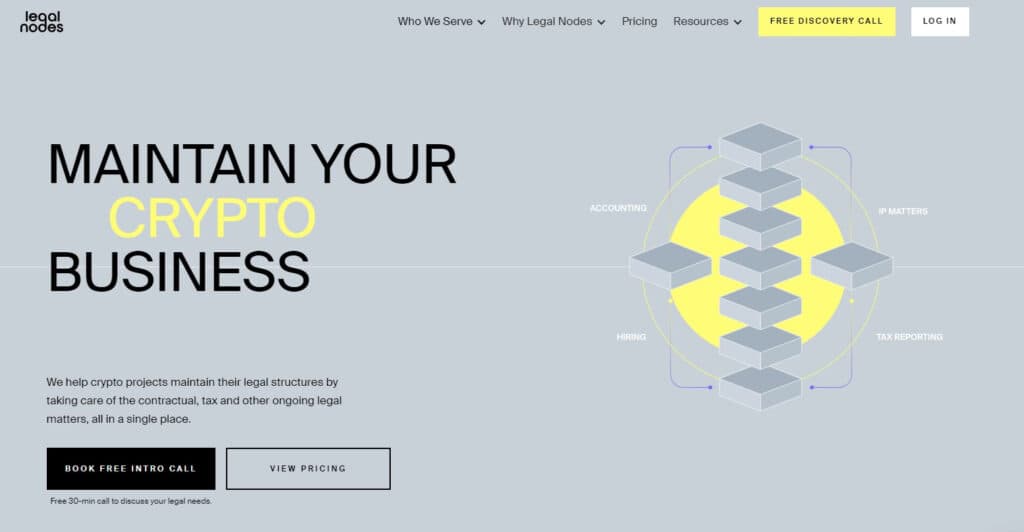
Legal Nodes runs a matching service for crypto legal work. The company connects clients with local attorneys in more than 20 countries instead of employing full-time lawyers directly. More than 400 crypto businesses have used their platform.
The firm’s crypto licensing lawyers begin every engagement with one question: does this business need a VASP license at all? Under current FATF guidance, any operation that holds crypto for third parties, converts one digital asset to another, or processes crypto payments likely falls under VASP rules. Token issuers, NFT platforms, and DeFi protocols sometimes sit outside the scope depending on how they are built.
The firm’s crypto license lawyers then help clients navigate jurisdiction selection based on budget, timeline, and target markets. For VASP licensing outside the EU, options include Switzerland (high credibility, moderate cost), the UK (high credibility, long timeline), and offshore jurisdictions like the BVI and Cayman Islands (lower cost, zero tax).
Legal Nodes does not file applications directly. Clients get one coordinator instead of hunting down lawyers in each country themselves.
5. LEXR
For crypto projects that want Swiss VASP status as a foundation for serving institutional clients.
LEXR is a Swiss-based crypto licensing law firm with over 30 legal professionals specializing in blockchain and crypto since 2016. The firm handles FINMA no-action letters, SRO affiliation, securities dealer licenses, and DLT trading facility licenses.
Switzerland operates two VASP pathways. SRO membership via VQF, ARIF, or PolyReg takes 2-4 months with a minimum capital of approximately CHF 20,000-50,000. Direct FINMA licensing takes 6-12 months with higher capital requirements but delivers bank-grade regulatory credibility. Corporate tax ranges from 8.5% to 12.5%.
LEXR’s crypto licensing attorneys know which SROs FINMA prefers for different business models. Their crypto license legal consultants run a two-hour workshop (CHF 3,800) covering structuring options, compliance strategies, and regulatory requirements. Clients receive a written summary with next steps, timelines, and fee estimates within 3-5 business days.
The firm’s people hold crypto themselves and use DeFi protocols. They lecture on blockchain law and sit on Swiss Blockchain Federation committees.
6. COREDO
For European crypto firms that want to understand how VASP regimes compare to CASP before deciding on a regulatory path.

COREDO started its licensing practice in Prague back in 2016. Since then, the team has delivered projects across the EU, Singapore, Dubai, the UK, Estonia, Cyprus, the Czech Republic, Slovakia, and Canada. Their jurisdiction selection matrix ranks potential countries across six blocks: regulatory regime, cost and timelines, substance requirements, banking ecosystem, tax predictability, and sanctions risks.
Their crypto licensing law firm practice includes VASP registration in jurisdictions outside the EU where the term remains active. Switzerland’s SRO pathway processes in 2-4 months. Bosnia and Herzegovina offers VASP licensing in Republika Srpska for USD 10,000-15,000 with a 3-6 month timeline. Jersey’s VASP Regime 2023 takes 8-14 months with 0% corporate tax subject to economic substance rules.
COREDO’s jurisdiction selection matrix ranks potential countries across six blocks: regulatory regime, cost and timelines, substance requirements, banking ecosystem, tax predictability, and sanctions and reputational risks. The firm does not guess which jurisdiction fits; they run the client’s business model through this matrix.
For VASP applicants considering EU markets, COREDO notes that Poland’s legislative process remains stalled following the presidential veto of the Crypto-Asset Act in February 2026. The window for using Poland as an EU passporting entry point has narrowed considerably.
7. Samson Solutions
For startups that want fixed pricing and fast entry into specific VASP jurisdictions.
Samson Solutions offers crypto licensing services across the Czech Republic, Lithuania, Poland, Estonia, and Slovakia. The firm publishes transparent pricing tables showing share capital requirements, corporate tax rates, local staff requirements, physical office needs, project timelines, and total costs for each jurisdiction.
For VASP registration in the Czech Republic, they offer licensing with no share capital requirement, no physical office required, and a three-week timeline starting at 1,900 EUR. In Lithuania, they handle the VASP-to-CASP transition for existing operators.
The firm has helped over 100 crypto and fintech projects, including ten major exchanges with combined annual turnover exceeding €1 billion. Their partners include Revolut, Sumsub, and Paydo.
What the 2026 VASP Landscape Actually Looks Like
Three major shifts define VASP licensing in 2026:
- The EU VASP window has closed. Before MiCA, Europe had over 3,000 registered VASPs, with Poland alone accounting for more than 1,400 registrations. As of May 2026, only 194 authorised CASPs exist. An estimated 75% of the pre-MiCA VASP population will lose registration status when transitional periods expire on July 1, 2026.
- Offshore VASPs face new scrutiny. FATF’s March 2026 report on offshore VASPs identified key exploitation methods: nested exchange arrangements where unlicensed oVASPs access liquidity through regulated hosts, global customer pooling that fractures accountability, and fragmented Travel Rule implementation creating investigative blind spots. Only 29% of jurisdictions are largely compliant with FATF’s VASP requirements.
- Non-EU jurisdictions are absorbing VASP demand. El Salvador granted over 100 licenses by the end of 2024, now hosting more than half the number of all EU CASPs. Costa Rica sees rising interest despite no dedicated licensing regime, offering zero tax on foreign-sourced income. The BVI remains an established offshore hub with dozens of registered VASPs, near-zero corporate taxation, and a frictionless incorporation process.
Bottom Line
VASP licensing in 2026 means different things depending on where a company looks. Switzerland offers speed through SRO membership (2-4 months) and credibility through FINMA. The UK delivers institutional trust but requires 6-18 months and survives a high rejection rate. Offshore jurisdictions like Jersey and the BVI provide zero corporate tax with substance requirements.
The EU VASP window is effectively closed. Poland’s register stopped accepting new entrants after December 30, 2024. Existing VASP holders in EU member states must transition to CASP by July 1, 2026, or exit the market.
A crypto business legal setup firm that understands VASP licensing knows which jurisdictions still accept new applicants and which have already transitioned to CASP. The firms listed here cover the active VASP regimes: Switzerland, the UK, Gibraltar, Jersey, Bosnia, and Georgia.
The question is not just where to get a VASP license but which jurisdiction matches the business model on cost, timeline, tax treatment, and long-term regulatory stability. Choose the firm that knows the differences and has done the work in the target country.